Sitemap
A list of all the posts and pages found on the site. For you robots out there, there is an XML version available for digesting as well.
Pages
Posts
Future Blog Post
Published:
This post will show up by default. To disable scheduling of future posts, edit config.yml and set future: false.
Blog Post number 4
Published:
This is a sample blog post. Lorem ipsum I can’t remember the rest of lorem ipsum and don’t have an internet connection right now. Testing testing testing this blog post. Blog posts are cool.
Blog Post number 3
Published:
This is a sample blog post. Lorem ipsum I can’t remember the rest of lorem ipsum and don’t have an internet connection right now. Testing testing testing this blog post. Blog posts are cool.
Blog Post number 2
Published:
This is a sample blog post. Lorem ipsum I can’t remember the rest of lorem ipsum and don’t have an internet connection right now. Testing testing testing this blog post. Blog posts are cool.
Blog Post number 1
Published:
This is a sample blog post. Lorem ipsum I can’t remember the rest of lorem ipsum and don’t have an internet connection right now. Testing testing testing this blog post. Blog posts are cool.
gallery
A fine example of Indian architecture
Published:
View of the sandy shores, Kerala India
Published:
View of the kovalam beach, Kerala India
Published:
Visit to Dr. Kalam’s Home
Published:
Rameshwaram beach
Published:
gopu_visit
Published:
bhaswati visit
Published:
ReTCO-6 2025
Published:
ReTCO-6 2025
Published:
publications
VaTEST I: Validation of Sub-Saturn Exoplanet TOI-181b in Narrow Orbit from its Host Star
Priyashkumar Mistry, Kamlesh Pathak, Georgios Lekkas, Aniket Prasad, Surendra Bhattarai, Mousam Maity, Charles A. Beichman, David R. Ciardi, Phil Evans, Allyson Bieryla, Jason D. Eastman, Gilbert A. Esquerdo and Jennifer P. Lucero
Published in Monthly Notices of the Royal Astronomical Society (MNRAS), 2023
First paper of VaTEST collaboration confirming TOI 181b.
VaTEST II: Statistical Validation of 11 TESS-Detected Exoplanets Orbiting K-type Stars
Priyashkumar Mistry, Kamlesh Pathak, Aniket Prasad, Georgios Lekkas, Surendra Bhattarai, Sarvesh Gharat, Mousam Maity, Dhruv Kumar, Karen A. Collins, Richard P. Schwarz, Christopher R. Mann, Elise Furlan, Steve B. Howell, David Ciardi, Allyson Bieryla, Elisabeth C. Matthews, Erica Gonzales, Carl Ziegler, Ian Crossfield, Steven Giacalone, Thiam-Guan Tan, Phil Evans, Krzysztof G. Helminiak, Kevin I. Collins, Norio Narita, Akihiko Fukui, Francisco J. Pozuelos, Courtney Dressing, Abderahmane Soubkiou, Zouhair Benkhaldoun, Joshua E. Schlieder, Olga Suarez, Khalid Barkaoui, Enric Palle, Felipe Murgas, Gregor Srdoc, Maria V. Goliguzova, Ivan A. Strakhov, Crystal Gnilka, Kathryn Lester, Colin Littlefield, Nic Scott, Rachel Matson, Michael Gillon, Emmanuel Jehin, Mathilde Timmermans, Mourad Ghachoui, Lyu Abe, Philippe Bendjoya, Tristan Guillot and Amaury H.M.J. Triaud
Published in Astronomical Journal (AJ), 2023
We perform wide search and statistical validation using TESS data, focusing on candidates around K-type Stars
Statistical Validation of 11 TESS-exoplanets orbiting K-Type stars
Published in Sagan Summer Workshop 2023, Pasedena, 2023
Presented our work on exoplanet validation as a poster

VaTEST III: Validation of 8 Potential Super-Earths from TESS Data
Priyashkumar Mistry, Aniket Prasad, Mousam Maity, Kamlesh Pathak, Sarvesh Gharat, Georgios Lekkas, Surendra Bhattarai, Dhruv Kumar, Jack J. Lissauer, Joseph D. Twicken, Abderahmane Soubkiou, Francisco J. Pozuelos, Jon Jenkins, Keith Horne, Steven Giacalone, Khalid Barkaoui, Mathilde Timmermans, Cristilyn N. Watkins, Ramotholo Sefako, Karen A. Collins, David R. Ciardi, Catherine A. Clark, Boris S. Safonov, Avi Shporer, Joshua E. Schlieder, Zouhair Benkhaldoun, Chris Stockdale, Carl Ziegler, Emily A. Gilbert, Emmanuël Jehin, Felipe Murgas, Ian J. M. Crossfield, Martin Paegert, Michael B. Lund, Norio Narita, Richard P. Schwarz, Robert F. Goeke, Sergio B. Fajardo-Acosta, Steve B. Howell, Thiam-Guan Tan, Thomas Barclay, and Yugo Kawai
Published in Publications of Astronomical Society of Australia (PASA), 2024
We statistically validate eight potential super-Earths using TESS data, focusing on candidates near the radius valley.
Recommended citation: Mistry, P., et al. (2024). "VaTEST III: Validation of 8 Potential Super-Earths from TESS Data." PASA. DOI:10.1017/pasa.2024.29
Download Paper
Investigating Outburst Dynamics of Ultraluminous X-Ray Pulsar Swift J0243.6+ 6124
Published in 6th biannual conference on Recent Trends in Compact Objects at Indian Institute of Technology Indore, India, 2025
This was part of the work undertaken during master’s thesis
research
Drift Mode identification in multi-band uGMRT observation of PSR J0034-0721
Published:
Worked on the single-pulse analysis of radio pulsars under Dr Manoneeta Chakraborty funded by Indian Academy of Science summer research fellowship. We aimed to identify the different drift modes exhibited by this pulsar during previous studies with GMRT and MWA. The frequency dependance of the drifting is essential to understand the emission of the radio pulsars. The work was very helpful as a stepping stone in the field of astronomy gaining in-hand experience with radio pulsar analysis.
Deep learning for Gravitational Wave event localization
Published:
I got a chance to test my deep learning lessons through a summer internship with Dr. Linqing Wen’s group at University of Western Australia being part of Ozgrav team. I collaborated with Dr. Chayyan Chaterjee, then doctoral candidate of Dr. Linqing working on training a mixture density model using tensoflow with a probablistic layer to predict the sky localizations of merger events. The work was adjudged the people’s choice winner of the 3-Mintue-thesis styel competition held at UWA for all summer interns.
Statistical study of super-Mercuries
Published:
Also worked as an intern with Dr. Verdan Adibekyan and his group in Instituto de Astrofísica e Ciências do Espaço (IA) on testing the hypothesis that super-Mercuries form a distinct population compared to super-Earths and thereby have different formation channels.
Statistical validation of TESS exoplanet candidates
Published:
The VaTEST project focuses on the statistical validation of exoplanet candidates discovered by NASA’s TESS mission. Initiated in May 2022, the project employs probabilistic frameworks and diagnostic tools to distinguish true planetary signals from astrophysical false positives. Combining photometric and spectroscopic data analysis with Python-based validation pipelines, VaTEST aims to robustly confirm exoplanets—especially those lacking radial velocity follow-up—by computing false positive probabilities and planet likelihoods. The ongoing effort is expanding toward the bulk validation of unconfirmed candidates to accelerate population-level studies of exoplanets. 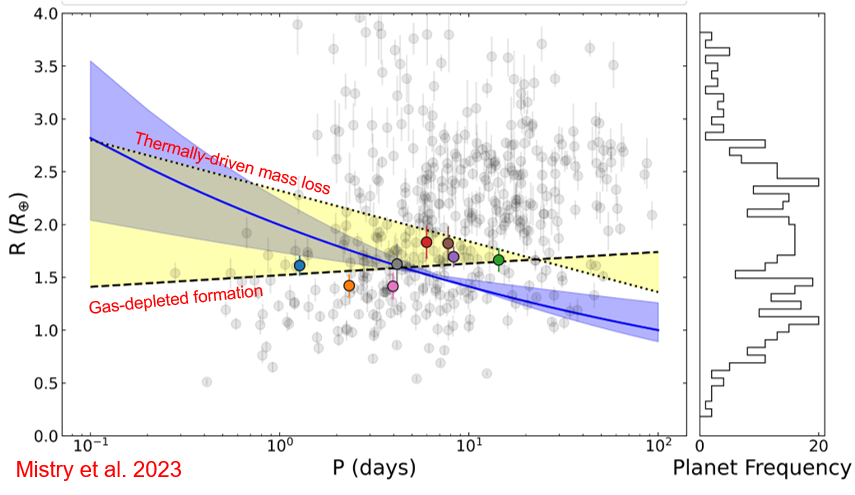
plot taken from Vatest 3 where we manage to validate several keystone exoplanets
Accretion onto Ultraluminous X-ray Pulsars
Published:
Ultraluminous X-ray pulsars (ULXPs) are a rare and intriguing class of accreting neutron stars capable of sustaining super-Eddington luminosities. Among them, Swift J0243.6+6124 stands out as the only confirmed Galactic ULXP, making it an ideal target for studying emission variability across changing accretion regimes. As part of my master's thesis, we conduct a detailed spectro-temporal analysis of this source during its 2023 normal outburst, using observations from the NICER mission in the 0.7–10 keV range, supplemented by INSIGHT-HXMT for higher energy coverage (upto 250 keV).
These insights aim to further our understanding of emission geometry and accretion dynamics in highly magnetized neutron stars operating in extreme luminosity regimes. The mystery of extreme luminosity obtained by accretion onto neutron star remains an open research question with physics of super-eddington accretion brought into question due to the kind of compact objects acting as central engine.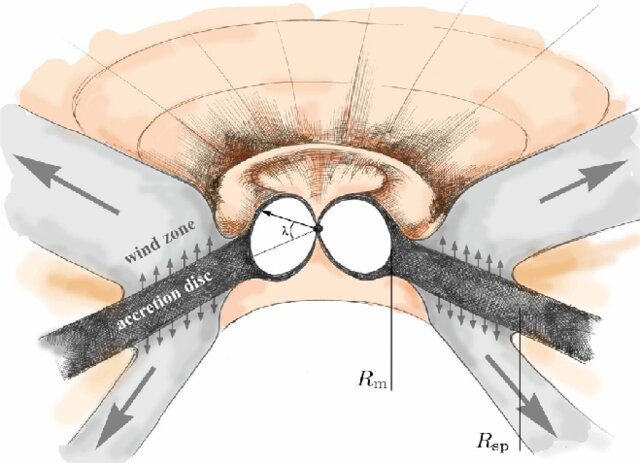
*Figure: Schematic of super-Eddington accretion onto a ULXP(Mushtukov et al. 2017, 2019)*
talks
Exoplanets: From Detection to Characterisation
Published:
Gave a public talk as part of Conscentia, the annual science and tech festival of IIST. The session explored the evolution of exoplanet science; from early radial velocity discoveries to modern TESS-based statistical validation pipelines. Highlighted the broader role of population studies in understanding planetary system architectures.
Introduction to Astronomy
Published:
Delivered an invited introductory session on the fundamentals of observational and theoretical astronomy, organized by India Space Lab for early-stage learners. The talk covered celestial coordinate systems, types of telescopes, key observational tools, and a survey of interesting cosmic structures like stars, galaxies, and exoplanets. It aimed to spark curiosity and provide a launchpad for deeper engagement with modern astronomy.
Data-Driven Aspects in Astronomy
Published:
Presented a series of lectures and interactive sessions as part of a week-long summer school hosted by the India Science Academy. The sessions focused on how data science and statistical modeling have revolutionized modern astrophysics — with emphasis on time-domain astronomy, exoplanet detection, and accessing astronomy data. Topics included Python workflows, machine learning, and data-driven discovery pipelines in astronomy.